
AI in customer service: an inevitable evolution
Over the past few years, artificial intelligence has been progressively reshaping customer service and the BPO industry. Task automation, chatbots, data analysis, predictive tools, use cases continue to multiply. Yet one key question remains central for both companies and employees: will AI replace the contact center agent?
At iKanbi, our conviction is clear!
AI does not replace humans, it empowers them.
In a context where customer expectations are rising, interactions are becoming more complex, and operational pressure is intensifying, the challenge is no longer to choose between technology and human interaction, but to make them work together in a smart and responsible way.
The challenges facing Business Process Outsourcers
Today, BPO players are facing several major challenges simultaneously.
End customers expect fast, personalized, and consistent responses across all channels. Products and services are becoming increasingly complex, making customer requests more technical and requiring a high level of expertise. Performance requirements (SLA, CSAT, FCR, NPS…) continue to grow.
At the same time, economic pressure is increasing. Large clients are seeking to optimize customer service costs while maintaining, or even improving, the quality of the delivered experience. Reducing cost per interaction, improving volume management, limiting employee turnover, and reducing costs linked to poor quality have become strategic priorities.
Finally, contact centers must deal with structural challenges in recruitment, training, and talent retention, within an increasingly tight labor market.
To address these challenges, more than 50% of customer interactions will be augmented by artificial intelligence by the end of 2026, not to eliminate the human role, but to simultaneously improve operational performance, service quality, and cost control, according to a study conducted by Gartner.
It is within this context that the concept of the augmented agent emerges.
What is an Augmented Agent ?
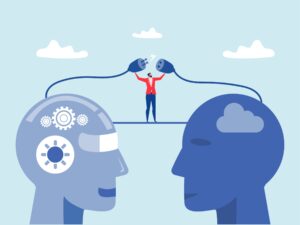
The augmented agent is an advisor who leverages artificial intelligence tools to access information more quickly, receive real-time assistance, and focus on what truly creates value in customer service: relationship-building, active listening, and resolving complex situations. AI thus becomes a true co-pilot, supporting the agent without ever replacing their judgment.
In practical terms, these technologies can take various forms: real-time response suggestions, customer sentiment analysis during interactions, automatic conversation summaries, assistance with request qualification, or alerts on sensitive situations.
Generative AI will be capable of increasing contact center agent productivity by 30 to 45%, while improving perceived service quality for customers and reducing operational costs per interaction.
The impact of the Augmented Agent on customer service quality
The impact on customer service quality is immediate. By reducing information search time and providing contextual support, AI enables agents to respond faster and more consistently, even on complex topics. Errors decrease, handling time is optimized, and first contact resolution rates improve.
In addition, intelligent customer data analysis enables a higher level of interaction personalization. Agents can adapt their messaging, tone, and proposals based on each customer’s history and context.
Companies that combine artificial intelligence and human intelligence within their customer journeys achieve satisfaction scores that are 10 to 20% higher.
A Major lever for the employee experience
The augmented agent is not only a driver of external performance, it is also a key factor in improving the employee experience. AI tools significantly reduce agents’ cognitive load by automating time-consuming tasks such as note-taking, reporting, and information retrieval. Employees can focus on their core role and work with greater peace of mind.
AI also becomes a tool for continuous skills development. Through personalized recommendations, contextual feedback, and improvement suggestions embedded directly into workflows, learning becomes progressive and practical.
Organizations that invest in augmented work environments see lower turnover rates, higher employee engagement, and sustained improvements in individual performance.
Why humans remain irreplaceable
That said, humans remain irreplaceable. Artificial intelligence excels at data processing, but it cannot replace empathy, nuanced emotional understanding, or the ability to manage sensitive or conflict-driven situations. A dissatisfied customer is not only looking for the right answer; they are above all seeking to be understood.

This is precisely where the augmented agent finds its true purpose: technology amplifies human capabilities without ever erasing them.
At iKanbi, we integrate AI as a strategic tool serving both performance and customer relationships. Its deployment is guided by clear processes, trained teams, ethical governance, and a constant focus on service quality.
Our objective is not automation at all costs, but the design of intelligent solutions capable of adapting to the specific challenges of each client and each campaign.
Want to go further ?
iKanbi supports its clients in implementing BPO solutions that intelligently integrate artificial intelligence, serving economic performance, service quality, and the human experience.
Are you wondering how AI could optimize your customer service without compromising relationships or employee engagement?
Our experts are available to discuss your challenges and objectives.